Skip to content
STAGING
STAGING
  • Home
  • About Our Sponsor
  • About Our Writers
  • Lawhill Maritime Educational Trust
Search:
  • Home
  • About Our Writers
  • About Our Sponsor
  • Lawhill Maritime Educational Trust
  • Maritime Economics
    • Maritime Economics Grade 10
    • Maritime Economics Grade 11
    • Maritime Economics Grade 12
  • Nautical Science
    • Nautical Science Grade 10
    • Nautical Science Grade 11
    • Nautical Science Grade 12

International time zones and the international date line

You are here:
  1. Home
  2. Maritime Economics Grade 11
  3. International time zones and the…

To revise the main facts in this section, go to the section in the Grade 10 site.

Remember the following from that section :

  • For every 15˚ of longitude, the sun time changes by 1 hour.
  • Port A (to the east of Port B) will be ahead of Port B in time.
  • Port C (to the west of Port D) will be behind Port D in time.
  • A ship crossing the International Date Line from east to west (e.g. from the Pacific coast of Canada to China) will advance her clocks 24 hours of time.
  • A ship crossing the International Date Line from west to east (e.g. from New Zealand to Panama Canal) will subtract (miss) 24 hours of time.


Calculating the Expected Time of Arrival (ETA) of a ship


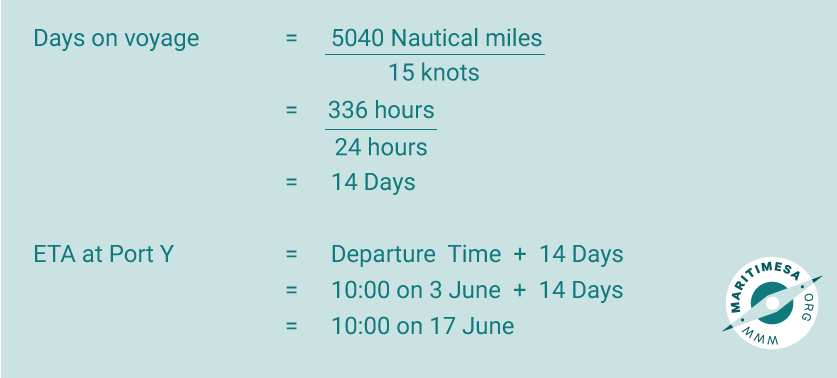
Example A: What is the ETA of the ship in Port Y at Port Y’s time?

Given facts :
Port of Departure Port X (15˚W)
Time of Departure 10:00 on 3 June
Port of Destination Port Y (135˚E)
Distance to be steamed  5040 Nautical Miles
Average Speed  15 knots

11.1.3_Voyage_calculations_1

But this time of arrival at Port Y is 10:00 on 17 June at Port X’s time.

We need to convert this to ETA the local time at Port Y.
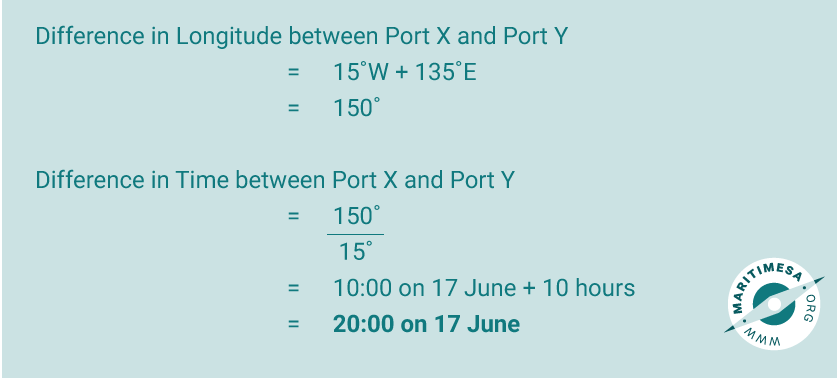
11.1.3_Voyage_calculations_2


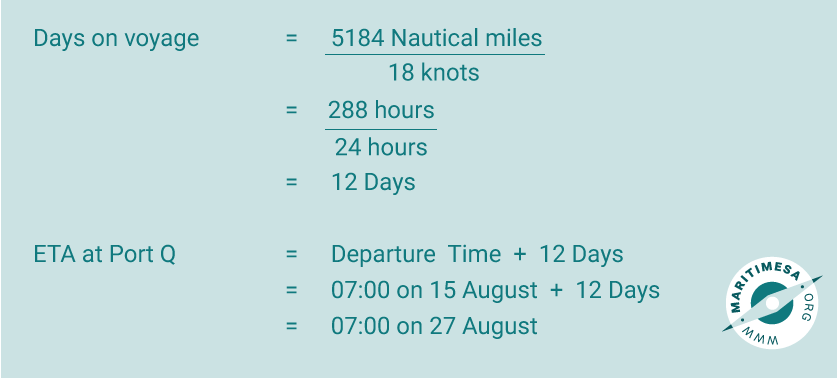
Example B: What is the ETA of the ship in Port Q at Port Q’s time?

Given facts :
Port of Departure Port P (45˚E)
Time of Departure 07:00 on 15 August
Port of Destination Port Q (120˚W)
Distance to be steamed 5184 Nautical Miles
Average Speed 18 knots

11.1.3_Voyage_calculations_3

But this time of arrival at Port Q is 07:00 on 27 August at Port P’s time.

We need to convert this ETA to the local time at Port Q.
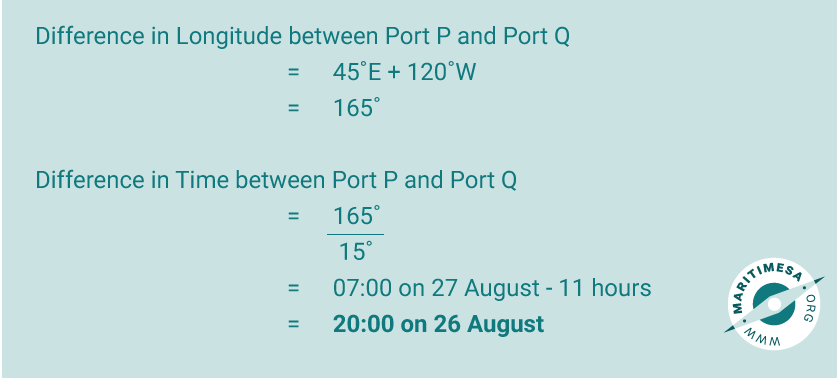
11.1.3_Voyage_calculations_4


Example C:

This is an interesting example because it includes actual ports, actual distance and a ship crossing of the International Date Line while steaming between those ports.

Given facts :
Port of Departure Valparaiso, Chile (Takes its time from 60oW)
Time of Departure 09:30 on 25 May
Port of Destination Sydney, Australia (Takes its time from 150oE)
Distance to be steamed  6281 Nautical Miles
Average Speed 20 knots

Let’s go to www.sea–distances.org and follow the steps below.

Click Voyage Calculator.

Click Add Port.

Go to the box, select Chile and then select Valparaiso.

Click Add Port.

Go to the box, select Australia and then select Sydney.

Enter also the speed (20 knots).

Now change the ETD from Valparaiso to 0930 on 25 May.

A calculation will be done automatically.

Now note how many days it will take to steam from Valparaiso to Sydney.

Note also the ETA at Sydney.

BUT the calculation has not taken into account the fact that the ship has crossed the International Date Line from east to west. This means that we need to advance the time by 24 hours, i.e. add 24 hours to the given ETA at Sydney.

← Previous LessonContainersNext Lesson →Engineering Officer
← Maritime Economics — Grade 11
11 Introduction▾
IntroductionTest Yourself 1 - Grade 11Test Yourself 2 - Grade 11
All the Grade 11 videos
11.1 The Maritime World▾
Lloyd’s Register of ShipsCape TownDurbanEast LondonMajor ship repair facilities in South African portsMossel BayNgquraPort ElizabethRichard's BaySaldana BaySimon's TownSouthern African PortsTest Yourself: Southern African PortsAn example of other African ports : Walvis Bay, NamibiaTest Yourself: African portsTest Yourself: World PortsIron OreTrade routesCoalGrainOilContainersInternational time zones and the international date lineEngineering OfficerNavigating OfficerTraining, education and experience needed to pursue the various maritime related careers
11.2 Shipping Operations▾
Shipping OperationsRole of a harbour as the interface between sea transport and other modes of transport  Ship OwningThe Structure of Shipping CompaniesShip ManagementShipbrokingChartering ProceduresExamples of times when less cargo was availableExamples of times when much cargo was availableShip Chartering (“Hiring” a Ship)Ship scrapping (also known as ship recycling)ShipbuildingShips’ Agency OperationsTeach Yourself: Ship's Agency operationsBunkering (refuelling)Bunkering – for those planning to become marine engineersTest Yourself: BunkeringCargoworkTest yourself: Cargo workTest yourself: cargo workTime in PortStevedoringShip Repair and MaintenanceShip ChandlingSalvage OperationsSouth African Salvage OperationsThe Salvage OperationCalculation of Voyage Costs
11.3 International Trade▾
Principles governing trade and transportMajor global areas of supply and demandFactors influencing trade fluctuationsProcedures pertaining to shipping containersA Littoral State
11.4 Maritime Environmental Challenges▾
Maritime Environmental ChallengesEnvironmental aspects which could affect maritime operationsInfluence of Weather Systems on shipping operationsFishingExtracting minerals, oil and gas from the ocean floorAlternative Energy Sources
Share this
Share on WhatsAppShare on WhatsApp Share on LinkedInShare on LinkedIn Share on FacebookShare on Facebook Share on XShare on X
Maritime Ecconomics
  • Maritime Economics Grade 10
  • Maritime Economics Grade 11
  • Maritime Economics Grade 12
Nautical Science
  • Nautical Science Grade 10
  • Nautical Science Grade 11
  • Nautical Science Grade 12
Our Sponsor
Amsol

+001 234 56 78 hello@us.com

Go to Top